

Published at: Jul 14,2026

If you are running a startup, SME, or growing business in India, confusing bookkeeping with accounting can cost you more than just clarity. It can lead to missed GST credits, poor cash visibility, delayed compliance, and bad business decisions.
Here is the simple difference: bookkeeping records what happened, while accounting explains what it means and what you should do next.
Both functions matter. But they do not solve the same problem, and treating them as interchangeable often creates financial blind spots.
In this guide, you will learn the difference between bookkeeping and accounting, when your business needs each one, how they work together, and how to choose the right setup for better compliance, reporting, and growth.
Aspect | Bookkeeping | Accounting |
|---|---|---|
Main role | Records day-to-day financial transactions | Analyzes financial data and turns it into insights |
Focus | Accuracy, categorization, and completeness | Interpretation, compliance, planning, and decision-making |
Typical work | Invoices, expenses, bank reconciliation, ledgers, payroll support | P&L, balance sheet, tax planning, reporting, forecasting, advisory |
Time horizon | Daily or weekly | Monthly, quarterly, and annual |
Business outcome | Clean financial records | Better financial decisions |
Why it matters | Prevents errors and missed entries | Improves profitability, compliance, and growth planning |
If you want reliable day-to-day financial records, structured bookkeeping support is the starting point. If you also need reporting, strategic guidance, and financial leadership, a Virtual CFO adds the accounting and decision support layer.
Bookkeeping is the process of recording, organizing, and maintaining your business’s financial transactions. Every sale, purchase, payment, receipt, salary entry, vendor bill, and bank movement should be captured properly.
Bookkeeping creates the financial foundation of your business. If the foundation is weak, every report built on top of it becomes unreliable.
Recording sales and purchase transactions
Maintaining invoices, receipts, and payment records
Reconciling bank and credit card statements
Tracking accounts receivable and accounts payable
Supporting payroll entries and expense categorization
Organizing GST-related transaction data
In India, bookkeeping is not just about staying organized. It directly affects GST accuracy, vendor reconciliation, TDS tracking, statutory readiness, and cash flow visibility.
For example, if purchase invoices are not recorded correctly, you may lose eligible input tax credit. If bank reconciliation is delayed, you may not discover duplicate payments, bounced receipts, or cash leakage until it is too late.
Accounting takes the financial information created through bookkeeping and turns it into structured reports, analysis, compliance outputs, and business recommendations.
In other words, bookkeeping tells you what happened. Accounting tells you why it happened, what it means, and what to do next.
Preparing profit and loss statements, balance sheets, and cash flow reports
Reviewing margins, expenses, and working capital trends
Supporting tax planning and statutory compliance
Preparing management reports and monthly reviews
Forecasting cash runway and budgeting future expenses
Advising on growth decisions, funding readiness, and financial controls
Businesses that need a stronger finance function often combine routine execution with broader accounting and compliance support to improve reporting quality and reduce risk.
The easiest way to understand the difference is to think of bookkeeping as input and accounting as interpretation.
If your question is… | You need… |
|---|---|
Did we record every sale, expense, and bank transaction correctly? | Bookkeeping |
Why is our cash balance shrinking even though revenue is rising? | Accounting |
Are our GST figures and vendor entries complete? | Bookkeeping |
What is our actual profit after adjustments and overhead allocation? | Accounting |
Which customers are delaying collections and affecting cash flow? | Bookkeeping first, then accounting review |
Can we afford to hire, expand, or raise funding this quarter? | Accounting |
Many business owners assume they only need one of the two. In practice, most growing businesses need both. Without bookkeeping, your numbers are incomplete. Without accounting, your numbers are underused.
Imagine a D2C brand selling on multiple marketplaces.
Bookkeeping records sales, payment gateway receipts, returns, shipping costs, ad payments, vendor bills, GST entries, and bank transactions.
Accounting reviews contribution margin, reconciles settlement gaps, assesses cash burn, identifies unprofitable SKUs, and helps the founder decide whether the current growth is actually sustainable.
Now imagine a manufacturing company.
Bookkeeping keeps purchase invoices, expense entries, payroll support, and bank reconciliation accurate.
Accounting helps management understand product-level margins, working capital pressure, financing needs, and tax implications.
That is why businesses that outgrow basic financial hygiene often move from transaction tracking alone to a more structured monthly finance setup, such as monthly accounting support.
The short answer is: from day one.
If money is coming in or going out, bookkeeping is already necessary. Waiting until year-end creates backlogs, missing documents, and compliance stress.
You raise invoices or receive customer payments regularly
You pay vendors, freelancers, or employees
You are registered for GST
You want clean books before tax or funding discussions
You are still relying on scattered spreadsheets or WhatsApp-shared documents
You do not know your exact receivables or payables
Your bank balance and internal numbers rarely match
GST filings feel rushed every cycle
You discover missing invoices only when someone asks for them
You close the year with unfinished reconciliations
A business needs accounting as soon as the owner wants clarity, compliance confidence, or better decisions, not just records.
This becomes especially important when the business is growing, facing tighter margins, preparing for funding, or managing multiple financial obligations.
You want monthly financial reports you can actually use
You need help understanding profitability and cash flow
You are preparing for investor, lender, or due diligence conversations
You need stronger compliance review and reporting discipline
You want finance insights beyond basic transaction entry
Revenue is rising, but cash still feels unpredictable
You cannot explain margin movement month to month
You make decisions without reliable monthly reporting
You need budgets, forecasts, or board-ready numbers
You want leadership-level finance input without hiring a full-time CFO
Useful resource: If you are setting up your finance function or cleaning up your early-stage processes, this accounting guide for startups is a practical next read.
Bookkeeping and accounting are not competing functions. They are sequential and complementary.
A transaction happens — a sale, expense, payroll payment, vendor invoice, or tax payment.
Bookkeeping captures it — the transaction is recorded correctly with the right category and supporting detail.
Reconciliation validates it — bank balances, invoices, and payment records are matched.
Accounting reviews it — adjustments, classifications, summaries, and financial reports are prepared.
Management uses it — the business owner makes decisions based on actual financial insight.
When this workflow is strong, you get cleaner compliance, faster reporting, sharper decisions, and fewer surprises.
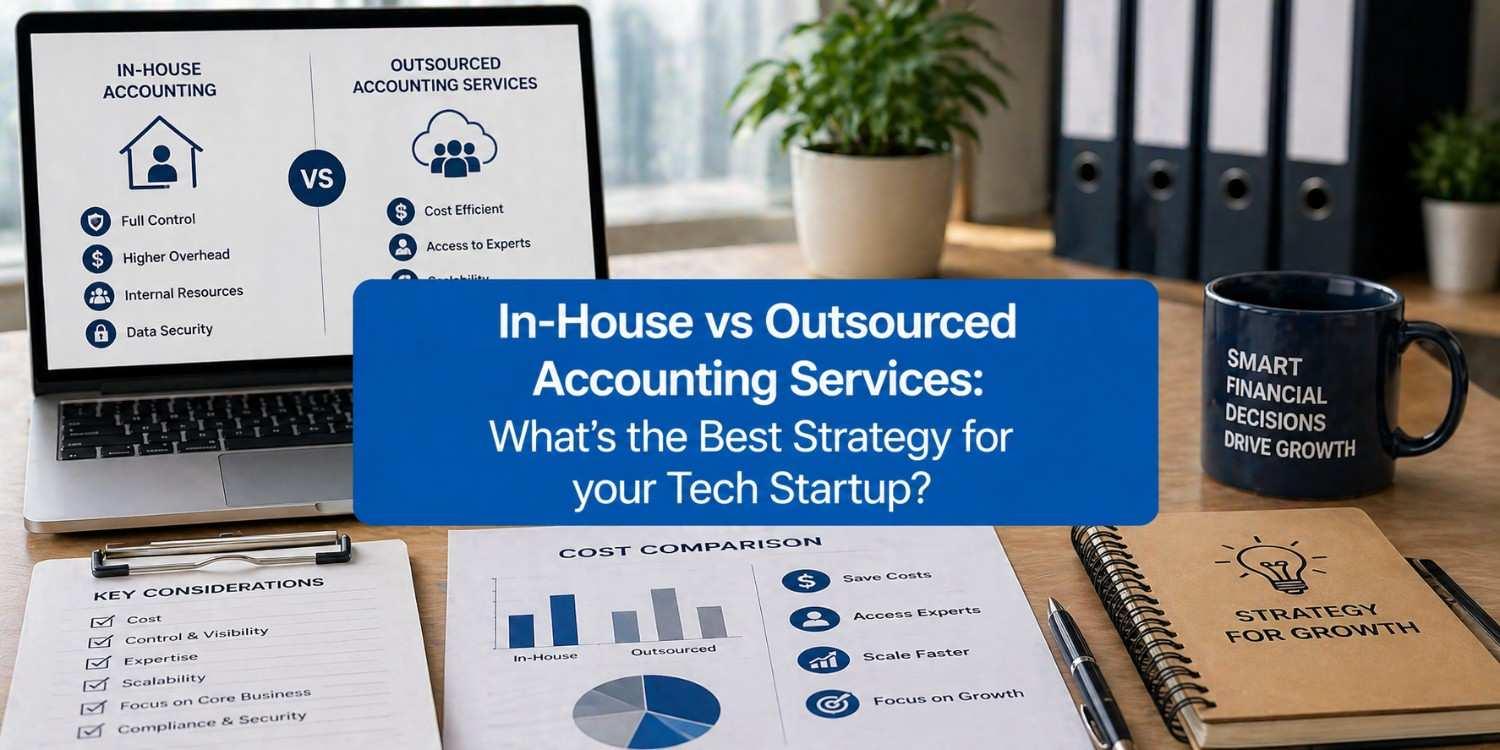
For many Indian startups and SMEs, the real decision is not bookkeeping versus accounting. It is whether to build the capability in-house, outsource it, or use a hybrid model.
Model | Best for | Advantages | Trade-offs |
|---|---|---|---|
In-house bookkeeping | Businesses with high transaction volume and daily coordination needs | Immediate access, internal familiarity, tight process control | Hiring cost, training effort, key-person dependency |
Outsourced bookkeeping | Startups and SMEs that need consistency without a full-time hire | Cost efficiency, process discipline, specialist support | Requires clear document flow and review rhythm |
Outsourced accounting or Virtual CFO | Growing businesses that need reporting, controls, and strategic finance input | Leadership-level insight without full-time CFO overhead | Works best when underlying bookkeeping is clean |
Hybrid model | Businesses with internal staff but external advisory needs | Combines operational control with expert review | Needs strong ownership and handoffs |
Weak transaction recording creates stronger-looking reports on paper than in reality. That disconnect becomes expensive during GST review, lender discussions, or year-end closing.
If entries are delayed, uncategorized, or unreconciled, even the best accountant cannot produce reliable insights.
Finance systems are hardest to fix under pressure. Clean records and regular review should start before the external trigger arrives.
Many businesses show revenue growth while struggling operationally because collections, inventory, or expense control are weak.
The cheapest option often becomes the most expensive when errors lead to rework, missed credits, penalties, or poor business decisions.
Your situation | What to prioritize |
|---|---|
New business with basic monthly transactions | Strong bookkeeping process from the beginning |
GST-registered business with vendor and customer volume | Bookkeeping plus regular compliance review |
Growing startup needing monthly financial clarity | Bookkeeping plus management accounting |
Founder preparing for fundraising, loans, or expansion | Accounting support with strategic finance oversight |
Business owner struggling with cash flow, margins, or reporting quality | Integrated finance support with deeper review and decision guidance |
Mid-article CTA: If you want a clearer view of what your business actually needs, book a meeting and get a practical finance workflow review based on your current stage.
Bookkeeping keeps your numbers clean.
Accounting makes your numbers useful.
You should not choose one instead of the other unless your business is extremely small and simple. In most real-world scenarios, bookkeeping is the operational base and accounting is the strategic layer built on top of it.
The difference between bookkeeping and accounting is simple, but the business impact is significant.
Bookkeeping helps you maintain complete and accurate financial records. Accounting helps you understand financial performance, stay compliant, plan ahead, and make smarter decisions. When both functions work together, your business gets cleaner reporting, fewer surprises, and stronger financial control.
If your current setup feels reactive, delayed, or unclear, that is usually a sign that your finance function needs more structure, not more stress.
Downloadable lead magnet: Ask for a simple monthly finance review checklist to evaluate whether your books, reconciliations, reporting, and compliance process are truly business-ready.
Final CTA: If you are ready to build a cleaner finance function with the right mix of bookkeeping, accounting, and strategic support, reach out through our contact page.
Bookkeeping is the process of recording financial transactions accurately and consistently. Accounting uses that information to prepare reports, ensure compliance, analyze performance, and support business decisions.
A very small business may begin with only bookkeeping, but growing businesses usually need accounting as well. Once you need cash flow visibility, profitability analysis, tax planning, or strategic reporting, bookkeeping alone is not enough.
Bookkeeping comes first. Accounting depends on clean and complete financial records. If bookkeeping is weak, accounting reports and decisions will also be unreliable.
You should expand beyond basic bookkeeping when your business starts facing compliance complexity, growth decisions, cash flow pressure, lender or investor discussions, or a need for regular monthly reporting.
Yes, for many startups and SMEs, outsourcing is a practical way to access experienced support without the cost of building a full internal finance team. It works especially well when you want process discipline, timely reporting, and scalable financial support.

August 18, 2026

Copyright © 2025 Easeupnow. All rights reserved.