


Published at: Dec 15,2024
Businesses reduce taxes and protect cash flow by planning both together. The practical answer is simple: forecast cash needs, set aside money for taxes, and use valid deductions, credits, and expense timing without hurting working capital. Review receivables, payables, payroll, inventory, and upcoming tax dues before making spending decisions. The goal is not to cut taxes at any cost. It is to stay liquid, compliant, and keep more cash available for growth.
Reducing taxes is not about "hiding" money; it is about strategic timing. By accelerating expenses and deferring income, businesses can lower their current tax bill and keep more cash available for immediate needs.
Accelerated Depreciation: Writing off the full cost of equipment in the first year.
Retirement Contributions: Lowering taxable profit while building long-term wealth.
Strategic Reinvestment: Spending on marketing or R&D at year-end to reduce profit.
Strategy | Impact on Tax | Impact on Cash Flow |
Section 179 Deduction | Significant decrease | High initial cash spend |
Prepaying Expenses | Moderate decrease | Immediate cash reduction |
Tax Credits (R&D) | Direct dollar reduction | Neutral (improves cash later) |
Profit and cash flow are not the same thing. You can have a high "paper profit" and be taxed on it, even if your bank account is empty because customers haven't paid their invoices yet.
Accounts Receivable: Slow-paying clients create a gap between tax liability and available cash.
Inventory Levels: Cash tied up in unsold stock is not tax-deductible until the product sells.
Debt Service: Interest is deductible, but the principal payment is not.
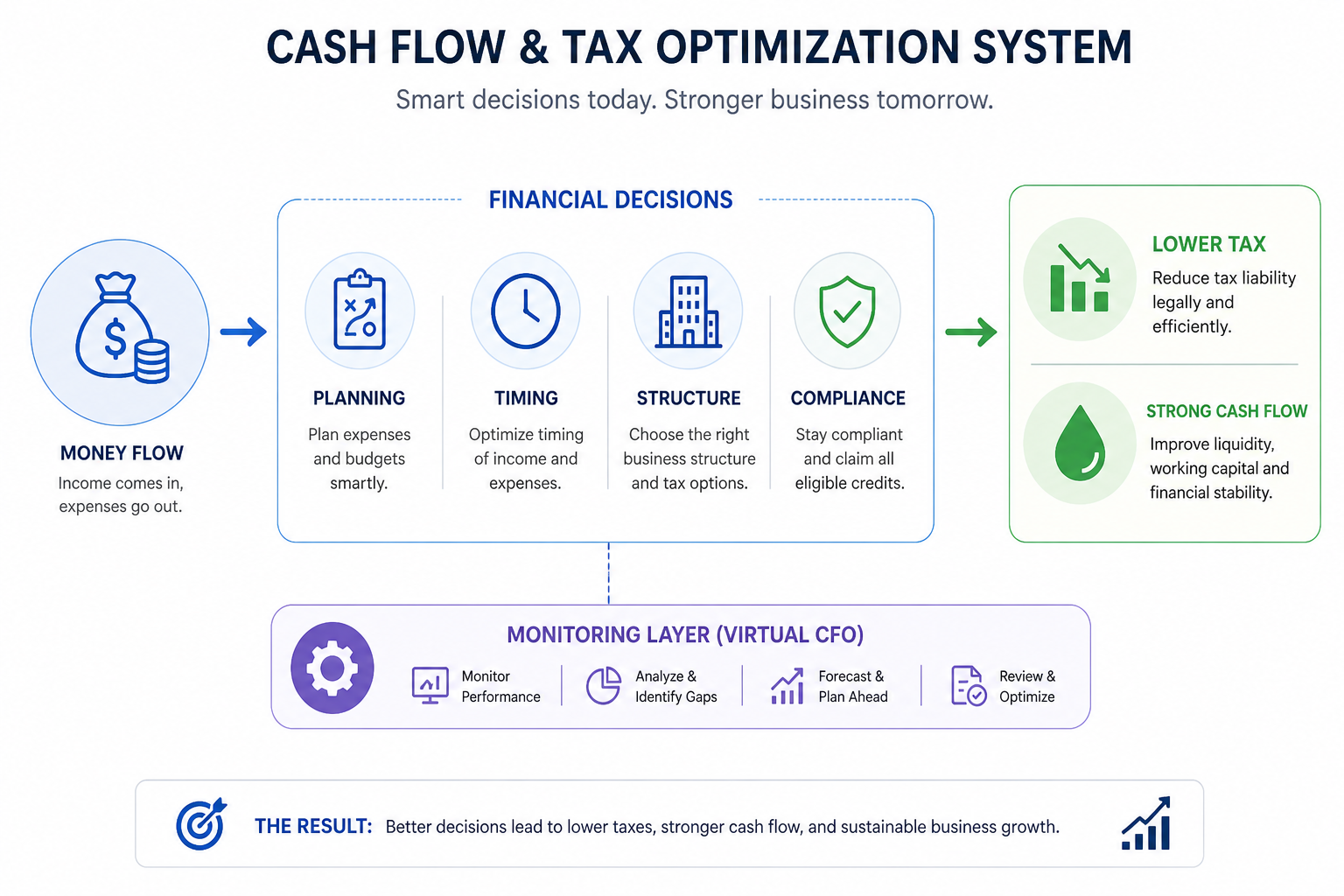
Growing businesses need to balance aggressive tax reduction with the need for capital to scale. The most effective strategies utilize credits that reward business activity.
R&D Tax Credits: For businesses developing new products or processes.
Hiring Credits: Incentives for hiring from specific demographics.
Entity Selection: Switching from a Sole Proprietorship to an S-Corp to reduce self-employment tax.
Business Stage | Recommended Strategy | Primary Benefit |
Startup | Founder's Stock / R&D Credits | Preserves early capital |
Scaling | S-Corp Election | Reduces payroll taxes |
Established | Defined Benefit Plans | Large tax deferrals |
Tax planning is impossible without accurate cash flow forecasting. If you don't know what your cash position will be in six months, you cannot safely commit to year-end tax-saving purchases.
Tax Reserves: Setting aside a percentage of every invoice for the IRS.
Quarterly Estimates: Avoiding underpayment penalties through consistent tracking.
Burn Rate Awareness: Ensuring tax strategies don't leave the company "cash poor."
Many owners focus so much on "zeroing out" their taxes that they accidentally starve their business of the cash needed to survive a slow month.
Buying Unnecessary Equipment: Spending $50k to save $15k in taxes is a net loss of $35k in cash.
Ignoring Deadlines: Penalties and interest are "dumb" expenses that provide no tax benefit.
Mixing Finances: Using business cash for personal taxes complicates the audit trail.
Most businesses are reactive rather than proactive. They wait until April to look at the previous year, at which point it is too late to change the outcome.
Lack of Real-Time Data: Making decisions based on bank balances instead of P&L statements.
Siloed Advice: The bookkeeper, tax preparer, and owner rarely speak the same language.
Complexity Bias: Assuming tax strategy is only for "big" corporations.
A Virtual CFO bridges the gap between accounting and strategy. They don't just record what happened; they predict what will happen and adjust the sails accordingly.
Scenario Modeling: "If we buy this warehouse, how does it change our tax bill?"
Cash Flow Forecasting: Predicting lean months to ensure tax payments are met.
Process Automation: Ensuring financial data is accurate and up-to-date daily.
Consider a marketing agency that earned $500k in profit. Without planning, they owe roughly $125k in taxes.
Before Planning: The agency keeps the cash in a checking account and pays the tax in April, causing a major cash crunch.
After Planning: The agency invests $40k in a new server (deduction), contributes $20k to a 401(k), and utilizes a $10k R&D credit.
Action Taken | Tax Saved | Cash Remaining |
No Action | $0 | $375,000 |
Strategic Spending | $22,000 | $397,000 (adjusted) |
You should consider a Virtual CFO when your financial complexity outpaces your ability to manage it on a Sunday afternoon.
Revenue Milestone: Usually between $1M and $10M in annual revenue.
Complex Payroll: Managing employees across multiple states or tax jurisdictions.
Inventory Intensive: When cash is constantly trapped in physical goods.
Tax planning is a year-round activity, not an April event.
Cash is king; never spend money on a deduction you don't actually need.
Use a "Tax Bucket" to separate tax money from operating capital immediately.
Hire expertise when the cost of a CFO is less than the money you are losing to inefficiency.
 Final truth: Efficient tax management is the art of keeping the maximum amount of cash inside your business for the longest possible time.

May 02, 2026

Copyright © 2025 Easeupnow. All rights reserved.