

Published at: Oct 29,2023
In the exhilarating world of startups, ideas are aplenty, but what transforms an idea into a tangible venture is financial backing. Seed funding is that crucial first injection of capital to set the stage for a startup's journey. As the startup ecosystem evolves rapidly, understanding the nuances of seed funding becomes indispensable -- particularly in India, where the funding landscape has its own distinct characteristics, regulations, and investor expectations.
This comprehensive guide covers everything an Indian founder needs to know: from understanding what seed funding entails, to navigating term sheets, managing your cap table, choosing the right instrument, and preparing for due diligence.
Seed funding is the initial capital raised by startups to kick-start their ventures. Often, it is the first official funding stage and can come after the founders have used their own resources to conceptualise and frame the business. While there are many stages of startup financing -- pre-seed, Series A, B, C, and beyond -- seed funding is distinctly positioned to help transform a nascent idea into a tangible business proposition.
In the Indian context, seed funding typically ranges from Rs 50 lakh to Rs 5 crore (approximately USD 60,000 to USD 600,000), though this range has expanded in recent years. The funding is used to validate the business model, build a minimum viable product, and establish initial market traction.
The Indian startup ecosystem has matured significantly, and the seed funding landscape reflects this evolution.
Average seed deal size: Rs 2-4 crore, up from Rs 1-2 crore five years ago
Number of seed deals: India sees approximately 600-800 seed-stage deals annually
Sectors attracting most seed capital: SaaS, fintech, healthtech, edtech, D2C brands, and climate tech
Time to close a seed round: Typically 3-6 months from first investor conversation to money in the bank
Investor Type | Examples | Typical Check Size |
|---|---|---|
Micro VCs | 100X.VC, Titan Capital, Better Capital, 2am VC | Rs 25 lakh - Rs 1.5 crore |
Early-Stage VCs | Blume Ventures, India Quotient, 3one4, Prime Venture Partners | Rs 2 crore - Rs 8 crore |
Angel Networks | Indian Angel Network, Mumbai Angels, LetsVenture, AngelList India | Rs 25 lakh - Rs 2 crore (syndicated) |
Accelerators | Y Combinator, Techstars, Antler India, Venture Catalysts | Rs 15 lakh - Rs 1.5 crore + mentorship |
Government Schemes | SIDBI Fund of Funds, Startup India Seed Fund, State startup policies | Rs 20 lakh - Rs 50 lakh |
The Government of India launched the Startup India Seed Fund Scheme with a corpus of Rs 945 crore, disbursed through selected incubators across the country. DPIIT-recognised startups (not older than 2 years) can receive up to Rs 20 lakh as a grant for validation and up to Rs 50 lakh as debt or convertible instruments. This is a non-dilutive or minimally dilutive source of capital that many founders overlook.
Seed funding is not merely about obtaining capital; it is a pivotal step that can define the trajectory of a startup. Here is why it is so crucial:
Seed funding can help convert a theoretical idea into a functional prototype or MVP (Minimum Viable Product). This MVP serves as a testament to the viability of the business idea. In India, building an MVP for a tech product typically costs Rs 10-30 lakh depending on complexity, while a D2C product MVP might require Rs 5-15 lakh for initial inventory and testing.
Great ideas need a robust team behind them. Seed funding empowers startups to hire essential talent, ensuring the idea is executed with finesse. In the current Indian market, a competent full-stack developer commands Rs 8-15 lakh annually, and a solid marketing hire costs Rs 6-12 lakh. Without seed funding, founders are limited to equity-only hires, which significantly narrows the talent pool.
Understanding your target audience is paramount. Seed funding aids in comprehensive market research, customer interviews, pilot programmes, and A/B testing -- leading to valuable customer feedback that shapes the product before significant capital is deployed.
Before revenues flow or the next funding round is secured, seed funding provides the necessary financial runway to keep operations smooth. The standard expectation is that seed funding should provide 12-18 months of runway, giving the startup enough time to hit milestones that justify a Series A raise.
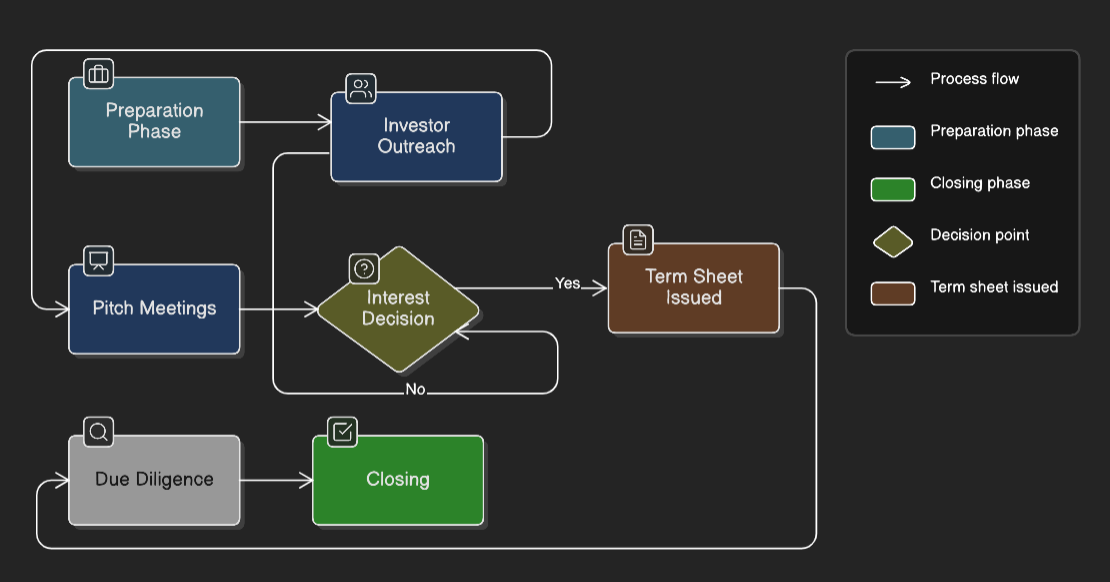
Understanding the typical process helps founders plan effectively and set realistic expectations.
Company structure: Ensure you are incorporated as a Private Limited Company (mandatory for most institutional investors in India). LLPs and proprietorships rarely receive VC funding.
DPIIT recognition: Apply for Startup India recognition, which unlocks tax benefits under Section 80-IAC and access to the Seed Fund Scheme.
Financial housekeeping: Clean up your books, file all pending returns, and ensure GST and income tax compliance is current.
Pitch deck creation: Build a 12-15 slide deck covering problem, solution, market size, business model, traction, team, financials, and the ask.
Data room preparation: Assemble all documents investors will request during due diligence (more on this below).
Identify target investors: Research which investors are active in your sector and stage. A SaaS startup pitching a D2C-focused fund is wasting everyone's time.
Warm introductions: In India, warm intros convert at 5-10x the rate of cold emails. Leverage your network, accelerator batchmates, and LinkedIn connections.
First meetings: Typically 30-minute calls or meetings. Investors assess the founder, the problem, and the opportunity.
Follow-up meetings: Deep dives into metrics, product demos, reference checks on the founding team.
Term sheet received: A non-binding document outlining the key terms of the investment.
Negotiation: Discussion on valuation, board seats, liquidation preferences, anti-dilution clauses, and vesting schedules.
Legal review: Engage a startup-experienced lawyer to review the term sheet. Budget Rs 1-3 lakh for legal fees at seed stage.
Due diligence: Investor's legal and financial team reviews all company documents.
Definitive agreements: SHA (Shareholders' Agreement) and SSA (Share Subscription Agreement) are drafted and signed.
Fund transfer: Shares are allotted, RoC filings are made, and funds hit your bank account.
A term sheet is the single most important document in a funding round. Here are the key terms Indian founders must understand before signing:
Pre-money valuation: The value of your company before the investment. If your pre-money is Rs 8 crore and an investor puts in Rs 2 crore, your post-money valuation is Rs 10 crore, and the investor owns 20%.
Typical seed valuations in India: Rs 5-20 crore pre-money, depending on traction, sector, and team.
This determines who gets paid first (and how much) in an exit event. A "1x non-participating" preference means the investor gets their money back first, then the remaining proceeds are distributed pro-rata. This is the most founder-friendly version. Be cautious of "participating" preferences or multiples above 1x at the seed stage.
Protects investors if a subsequent round is raised at a lower valuation (a "down round"). "Broad-based weighted average" is the standard and fair mechanism. Avoid "full ratchet" anti-dilution, which is highly punitive to founders.
At seed stage, a 3-member board with 2 founders and 1 investor nominee is standard. Avoid giving up board majority at the seed stage -- this can create governance issues later.
Most investors will require founders to vest their shares over 3-4 years with a 1-year cliff. This protects the company if a co-founder leaves early. Standard vesting in India is 4 years with a 25% cliff after year 1, and monthly vesting thereafter.
At seed stage, founders often face a choice between different funding instruments. Each has distinct implications under Indian company law.
What it is: Direct purchase of shares at a fixed valuation
Pros: Clean, simple cap table; clear ownership percentages; well-understood under Indian law
Cons: Requires agreeing on valuation upfront; higher legal costs (Rs 2-5 lakh); more time-consuming
Best for: Rounds above Rs 2 crore with institutional investors
What it is: Debt that converts to equity at a future trigger event (usually the next priced round)
Indian structure: Compulsorily Convertible Debentures (CCDs) are the standard instrument, as Indian companies cannot issue traditional convertible notes. CCDs must comply with Section 71 of the Companies Act and require a special resolution.
Key terms: Conversion discount (typically 15-25%), valuation cap, maturity period (18-24 months), interest rate (often nominal at 1-2%)
Pros: Defers valuation discussion; faster to execute; lower legal costs
Cons: Regulatory complexity under Indian law; RBI compliance for foreign investors; can create cap table confusion
Best for: Bridge rounds, angel investments under Rs 1 crore
What it is: A Y Combinator-created instrument -- essentially a convertible note without the debt component (no interest, no maturity date)
Indian context: SAFEs do not have a clear legal framework under Indian company law. They are increasingly used by Indian startups raising from US-based investors (in USD), but domestically, CCDs are preferred. Some lawyers structure India-SAFEs as a type of share warrant or CCD variant.
Pros: Simplest instrument; fastest to execute; standard terms
Cons: Regulatory ambiguity in India; not suitable for domestic-only rounds; RBI FEMA compliance issues for foreign holders
Best for: Startups raising from US-based investors in a US parent entity (flip structure)
Your cap table (capitalisation table) is a record of who owns what percentage of your company. Mismanaging it at the seed stage creates compounding problems in every subsequent round.
Founders should retain 65-80% post-seed: If founders are diluted below 60% at seed stage, it raises red flags for Series A investors who know further dilution is inevitable.
Create an ESOP pool of 10-15%: Most institutional investors will require an ESOP pool to be carved out before (or as part of) the seed round. Budget for this upfront so it does not come entirely from founder dilution.
Limit the number of investors: A cap table with 25 angel investors creates administrative nightmares. Aim for 3-5 investors at seed stage, or have angels invest through a single SPV (Special Purpose Vehicle).
Document everything: Every share issuance must have proper board resolutions, share certificates, and RoC filings. Sloppy documentation at seed stage becomes expensive to fix during Series A due diligence.
Shareholder | Shares | Percentage |
|---|---|---|
Founder 1 | 40,000 | 40% |
Founder 2 | 30,000 | 30% |
Seed Investor (Lead VC) | 15,000 | 15% |
Angel Investors (SPV) | 5,000 | 5% |
ESOP Pool | 10,000 | 10% |
Total | 1,00,000 | 100% |
For an investor, providing seed funding is more than just handing over a cheque; it is a belief in the potential of an idea and the team behind it. Here is what they typically scrutinise:
Market Potential: The bigger the problem, the bigger the opportunity. Investors want to know if the startup addresses a substantial market need and whether there is room for growth. In India, investors look for TAM (Total Addressable Market) of at least Rs 5,000 crore for venture-scale outcomes.
Team Strength: The founding team's expertise, passion, and execution ability can often be a deal-maker or breaker. Investors seek commitment and a team that complements each other's strengths. First-time founders are not at a disadvantage if they demonstrate domain expertise and coachability.
Uniqueness of the Idea: With countless startups vying for attention, those with a distinct edge or solution are likelier to pique an investor's interest. This does not mean the idea must be wholly original -- a better execution of an existing model in an underserved market is equally compelling.
Early Traction: While not always a prerequisite, demonstrating some initial traction or validation can significantly enhance a startup's appeal. This could be paying customers, waitlist signups, LOIs (Letters of Intent), or a successful pilot programme.
Revenue Model: Investors want a clear sight of returns. A viable, scalable revenue model is crucial. Unit economics need not be perfect at seed stage, but there should be a credible path to profitability.
Being prepared for due diligence accelerates the funding process and demonstrates professionalism. Keep these documents ready in a secure data room before you begin pitching:
Certificate of Incorporation and MOA/AOA
Board resolutions and minutes of all meetings
Share certificates and register of members
All existing shareholder agreements, if any
DPIIT Startup India recognition certificate
Audited financial statements (if available) or management accounts
Bank statements for the last 12 months
GST returns filed to date
Income tax returns for the company and founders
Financial projections for 3 years with assumptions clearly stated
Current MIS (Monthly Information Statement) showing revenue, expenses, and burn rate
Trademark and patent filings (if any)
Key contracts (client agreements, vendor agreements, employment agreements)
Any ongoing or past litigation
IP assignment agreements from founders and employees to the company
Organisational chart and key employee details
ESOP plan and grant letters (if applicable)
Product roadmap and technology architecture overview
Key metrics dashboard (MRR, churn, CAC, LTV, active users)
The quest for seed funding can be daunting, but with the right strategies, it becomes markedly easier:
Build a Strong Network: In the startup world, connections matter immensely. Attend industry events, join startup incubators, and engage with fellow entrepreneurs. In India, events like TiE conferences, Nasscom Product Conclave, and city-specific startup meetups are excellent networking opportunities.
Demonstrate MVP Success: Showcase the feasibility of your product. If you have user testimonials, metrics, or any other validations, bring them to the forefront. Even Rs 50,000 in monthly revenue can be a powerful signal at the seed stage.
Craft a Compelling Pitch Deck: A pitch deck is your business on paper. Make it concise, engaging, and packed with essential information. Highlight the problem, your solution, and the market potential. Keep it to 12-15 slides. Use specific numbers, not vague claims.
Understand Valuation Dynamics: Here is where the expertise of firms like EaseUp becomes invaluable. We provide unmatched insights into business valuation and startup funding. A realistic and fair valuation can make all the difference in attracting potential investors. Overvaluing at seed stage can make it impossible to raise a Series A at a higher valuation.
Transparency is Key: Every startup will have challenges. Being upfront about them, along with your plans to mitigate them, can build investor trust. Investors have seen hundreds of pitches -- they can detect evasion quickly.
Leverage Government Schemes: Explore the Startup India Seed Fund Scheme, state-level startup policies (Karnataka, Telangana, and Maharashtra have particularly active programmes), and SIDBI's Fund of Funds. These provide non-dilutive or low-dilution capital.
The road to seed funding is riddled with potential missteps:
Valuation Errors: Over or under-valuing your startup can have long-term repercussions. Overvaluation at seed sets unrealistic expectations for Series A, potentially leading to a down round. Under-valuation gives away too much equity too early. This is where having a firm like EaseUp by your side, with its deep-rooted expertise in startup valuation, proves indispensable.
Equity Mismanagement: Parting with too much equity early on can restrict your leverage in future funding rounds. If founders hold less than 50% after seed, it becomes very difficult to maintain control and motivation through Series A and beyond.
Wrong Investor Match: Not all money is good money. Aligning with investors who share your vision and ethos is critical. An investor who pushes for premature revenue at the expense of product development, or one who is unresponsive when you need strategic guidance, can be worse than having no investor.
Unclear Use of Funds: Investors want clarity. Always have a clear, documented plan for the utilisation of funds, broken down by category (product development, hiring, marketing, operations, compliance) and by quarter.
Ignoring Legal Structure: Raising money on a handshake or with poorly drafted agreements creates disputes later. Invest Rs 1-3 lakh in proper legal documentation -- it will save you Rs 10-20 lakh in future disputes.
Not Filing Section 56(2)(viib) Valuation: When an Indian private company issues shares at a premium, Section 56(2)(viib) of the Income Tax Act requires a valuation report to justify the premium. Without this, the premium amount can be taxed as income of the company. Many startups discover this requirement only during their next round's due diligence.
EaseUp is a beacon for startups navigating the tumultuous waters of seed funding. Our expert team, with 30+ years of combined experience, specialises in startup and tech company valuation. We believe in empowering startups with the best evaluation methods, ensuring a realistic and just valuation of your venture.
Our seed funding support includes:
Startup Valuation: Section 56(2)(viib) compliant valuation reports using DCF, comparable transaction analysis, and other SEBI-recognised methods
Financial Modelling: Building investor-ready financial projections and unit economics analysis
Cap Table Advisory: Structuring your cap table to remain founder-friendly while being attractive to investors
Due Diligence Preparation: Organising your financial and legal documents into an investor-ready data room
Virtual CFO Services: Ongoing financial management to ensure your books are clean and investor-ready at all times
Remember, a startup valuation is not just a number; it is a testament to your venture's worth and potential, making it an essential tool to attract investors. Every startup aiming to raise funds must have a startup valuation certificate, and that is precisely where EaseUp delivers.
Seed funding, while vital, is just one step in the thrilling journey of a startup. It is a phase that establishes the groundwork for subsequent expansion. By recognising its importance, preparing thoroughly, understanding the legal and financial nuances of the Indian ecosystem, and teaming up with specialists in startup funding services like EaseUp, startups can confidently pitch their vision and acquire the necessary capital to flourish.
The founders who succeed at raising seed funding are not necessarily those with the most innovative ideas -- they are the ones who are best prepared, most transparent, and most strategic about how they approach the process.
If you are a startup looking for insights, valuation, or just a guiding hand, EaseUp is here to help. Let us collaborate and unlock the value of your venture. Reach out today.
The standard range in India is 10-25% dilution at seed stage. Ideally, founders should retain at least 65-75% of the company post-seed (including the ESOP pool). Giving away more than 30% at seed makes it difficult to maintain majority ownership through subsequent rounds. The exact percentage depends on your valuation, the amount raised, and the strategic value the investor brings beyond capital.
Pre-seed funding is typically Rs 10-50 lakh, raised from friends and family, angel investors, or government grants. It is used to build a prototype and validate the basic idea. Seed funding is the first institutional or semi-institutional round, typically Rs 50 lakh to Rs 5 crore, used to achieve product-market fit and initial traction. The key difference is that seed investors expect a more developed product, some early metrics, and a clearer path to revenue than pre-seed investors.
Yes, for legal compliance. Under Section 56(2)(viib) of the Income Tax Act, when a closely held company issues shares at a premium to a resident investor, the premium must be justified by a valuation report from a registered valuer or a merchant banker. Without this, the premium is treated as taxable income of the company. Additionally, investors and their lawyers will require a valuation as part of their due diligence. EaseUp provides Section 56(2)(viib) compliant valuation reports that satisfy both regulatory and investor requirements.
Practically, no. Almost all institutional investors and most angel investors in India invest only in Private Limited Companies. This is because LLPs and proprietorships do not issue shares, making equity investment structurally impossible. If you are currently operating as an LLP or proprietorship and plan to raise seed funding, you should incorporate a Private Limited Company and transfer the business. This process takes 2-4 weeks and should be done before you begin pitching to investors.
Seed funding should provide 12-18 months of runway. In that period, the typical milestones expected before a Series A raise include: achieving product-market fit (measured by retention and engagement metrics), reaching Rs 5-15 lakh in monthly recurring revenue (for SaaS) or demonstrating consistent month-over-month growth of 15-20%, building a core team of 8-15 people, and having clear unit economics showing a path to profitability. Series A investors in India typically look for startups that have used their seed capital efficiently and can articulate exactly how Series A funds will accelerate an already-working model.

April 12, 2026


Copyright © 2025 Easeupnow. All rights reserved.