


Published at: Oct 28,2024
Startups often reach a "complexity tipping point" where DIY bookkeeping and basic accounting are no longer enough. To scale, you need high-level strategic oversight. While "Virtual" and "Fractional" CFOs are often used interchangeably, understanding the nuance in how they engage with your business can save you significant time and resources.
Choosing between a Virtual CFO and a Fractional CFO isn't about which is "better," but which fits your current growth stage.
Virtual CFOs (vCFOs) are remote-first, tech-driven partners best for routine financial health, standardized reporting, and maintaining compliance without the overhead of a full-time hire.
Fractional CFOs offer high-touch, hybrid, or on-site leadership, making them ideal for complex, high-stakes events like fundraising, mergers, or organizational pivots.
The Verdict: If you need consistent systems and visibility, go Virtual. If you are navigating a major strategic shift, go Fractional.
A full-time Chief Financial Officer (CFO) is a massive overhead, often commanding a significant six-figure salary, equity, and benefits. For many growing startups and SMEs, that level of commitment is unnecessary—or simply unaffordable.
The Outsourced CFO model (encompassing both Virtual and Fractional roles) bridges this gap. These roles offer corporate-grade financial leadership on a flexible, cost-effective basis, allowing you to focus on product and market growth while an expert manages your financial runway, fundraising readiness, and risk.
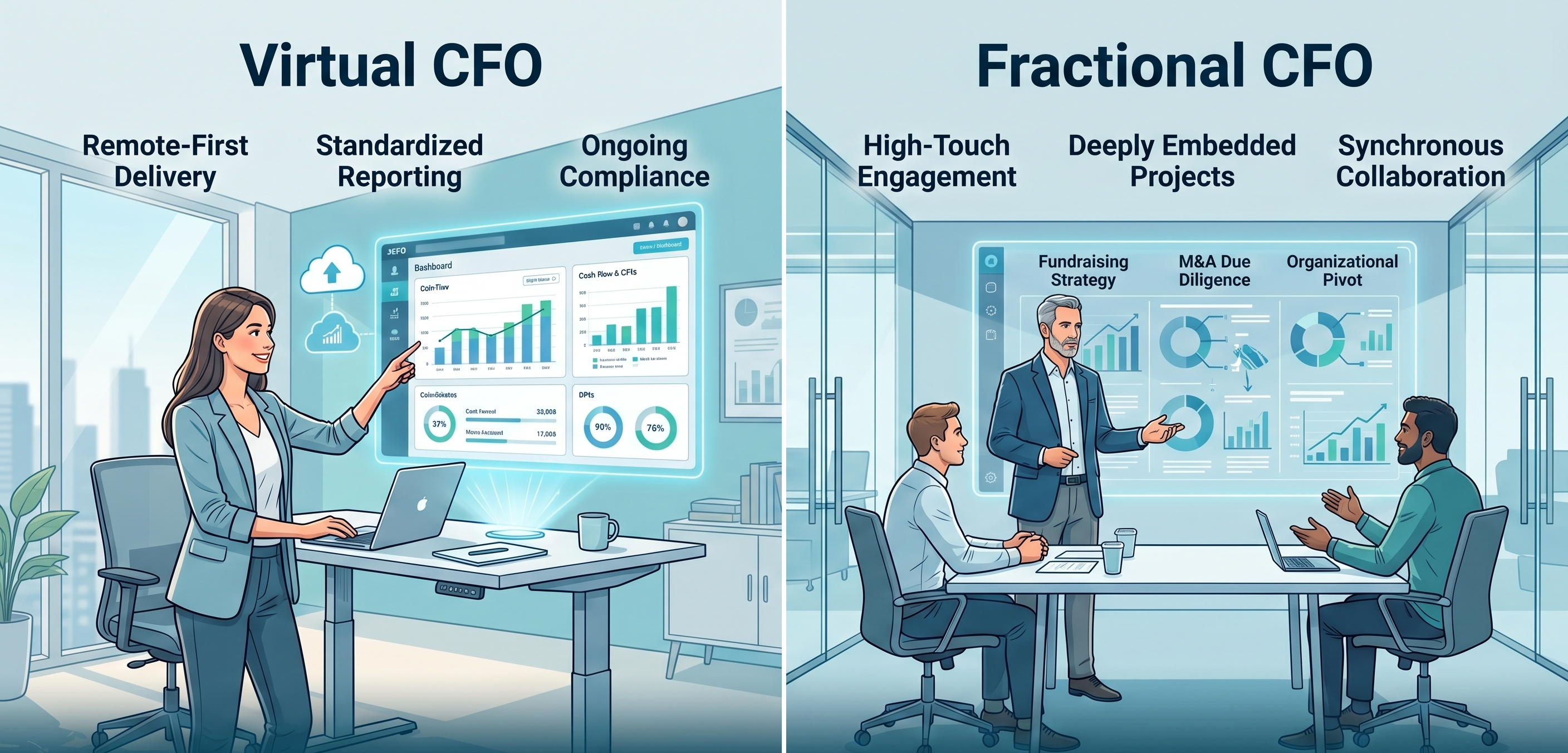
While both roles provide high-level strategy, the difference lies in their engagement model and depth of integration.
Feature | Virtual CFO (vCFO) | Fractional CFO |
Primary Delivery | 100% Remote-First | Hybrid / Flexible (can be on-site) |
Primary Focus | Standardized, Scalable Systems | Deeply Embedded Strategic Projects |
Best For | Ongoing Financial Health & Reporting | Fundraising, M&A, & Pivots |
Collaboration | Asynchronous (Dashboards, Calls) | Synchronous (Meetings, Board Presence) |
Integration | Standardized/Technology-driven | Deeply woven into team culture |

A Virtual CFO is an ideal choice if your business is digitally native, remote-first, or simply requires consistent, standardized financial reporting.
Streamlined Reporting: You need real-time visibility into cash flow, burn rate, and KPIs via cloud-based dashboards (e.g., Xero, Zoho).
Remote-Friendly: Your team is distributed, and you prefer digital collaboration over physical meetings.
Focus on Compliance: You need a partner to handle routine tax filings, GST compliance, and standard reporting without needing someone in your office.
Efficiency First: You want a cost-effective solution that leverages technology to automate day-to-day financial operations.

A Fractional CFO is often a better fit when your business is navigating a complex transition or "strategic moment" that requires high-touch collaboration.
Strategic Pivots: You are preparing for a major fundraising round, an IPO, or a potential merger/acquisition (M&A).
Hands-On Leadership: You need someone who can work closely with your core team, attend in-person board meetings, and mentor your internal finance staff.
Crisis Management: You are navigating a specific financial challenge that requires an expert to be deeply embedded in your operations for a period of time.
Stakeholder Alignment: You need to bridge the gap between your leadership team and investors, which often benefits from face-to-face interaction.
To choose the right model, evaluate your current stage and specific needs:
Complexity of Operations: Are you scaling across multiple geographies? If so, the deep integration of a Fractional CFO may be safer.
Fundraising Status: If you are actively pitching to VCs, a Fractional CFO brings the gravitas and experience to handle investor relations and due diligence in person.
Budget & ROI: While both are cheaper than a full-time hire, Virtual CFOs usually offer a more standardized, cost-effective pricing structure, while Fractional CFOs command higher rates for their deep-dive, project-based work.
At EaseUp, we don't believe in a one-size-fits-all approach. We provide both Virtual and Fractional support, ensuring that as your startup grows, your financial leadership evolves with you.
Whether you need remote-first operational support or a high-touch strategic partner to lead your next funding round, our team of experts provides the clarity and systems you need to scale with confidence.
The decision to outsource your financial leadership is a pivotal step in your startup's growth journey. Whether you require the ongoing, tech-enabled oversight of a Virtual CFO or the high-touch, strategic expertise of a Fractional CFO, the goal remains the same: to move from manual, reactive bookkeeping to proactive, scalable growth. By choosing the right model for your specific stage of development, you ensure that your business isn't just surviving—it's thriving.
Ready to align your financial strategy with your growth goals?
[Click here to schedule a free consultation with an EaseUp expert.]
Q: Are "Virtual" and "Fractional" CFOs basically the same thing?
A: They are similar, but the key distinction is the "depth" of engagement. A vCFO often manages standardized financial systems remotely, while a Fractional CFO is hired for specific, high-touch strategic outcomes.
Q: Which model is cheaper?
A: Virtual CFO services are typically more cost-effective because they are often delivered through a pre-defined scope of work and technology-driven processes.
Q: Can I switch from a Virtual CFO to a Fractional CFO?
A: Absolutely. Many startups begin with a vCFO to build solid financial foundations and "graduate" to a Fractional CFO when they are ready to pursue a major fundraising round or M&A.
Q: How do I know if I'm ready for either?
A: If you find that your financial reporting is reactive, your tax compliance is a struggle, or your leadership team is missing critical insights for growth, you are ready to outsource.

May 02, 2026

Copyright © 2025 Easeupnow. All rights reserved.